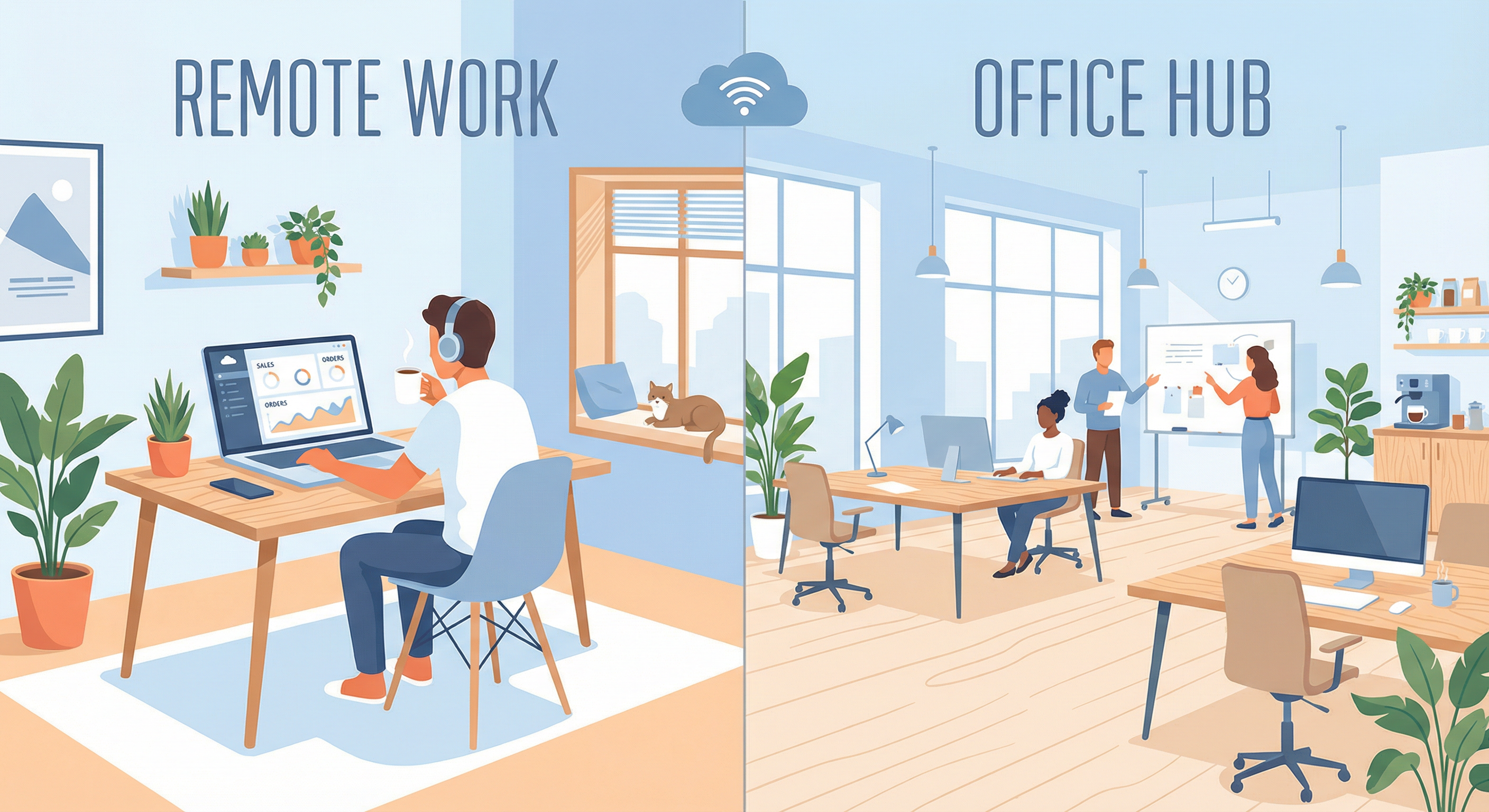

The e-commerce industry sits at a unique crossroads in the remote work debate. Unlike traditional retail, running an online store doesn't inherently require a physical location. Your entire business exists in the digital realm. Yet the question of whether to build your team remotely or in an office remains more nuanced than it might appear. The COVID-19 pandemic accelerated remote work adoption across all industries, but as we've settled into new routines, many e-commerce entrepreneurs are reconsidering what setup truly serves their business best.
The Case for Remote Work
Remote work offers compelling advantages for e-commerce businesses. Perhaps the most significant is access to a global talent pool. When geography is no barrier, you can hire the best developers, marketers, and customer service representatives regardless of where they live. This is particularly valuable in e-commerce, where specialized skills in areas like conversion optimization or marketplace management can be hard to find locally.
The financial benefits are substantial too. Without office rent, utilities, and associated overhead costs, you can redirect capital toward inventory, marketing, or technology investments that directly grow your business. According to Global Workplace Analytics, businesses can save an average of $11,000 per year for each employee who works remotely half of the time.
This is especially relevant for e-commerce businesses based in high-cost regions like Denmark. As a Danish software company ourselves at BravoShop, we know firsthand how expensive local talent can be. Danish developers often command salaries of €70,000 or more, while equally skilled developers in countries like Poland, Portugal, or Latin America might work for €30,000-40,000. For a Copenhagen-based webshop, hiring even one or two remote team members can free up tens of thousands of euros annually, capital that can make a real difference when competing on tight margins.
Remote work also offers flexibility that many employees now expect. For e-commerce businesses that operate across time zones or need customer service coverage outside traditional hours, distributed teams can provide natural coverage without requiring anyone to work inconvenient shifts.
The Case for Office-Based Work
Despite the advantages of remote work, there are compelling reasons to consider a physical workspace for your e-commerce operation. Communication happens faster when people share a space. The quick question across the desk, the impromptu brainstorming session, the ability to look at a screen together when troubleshooting an issue - these interactions are difficult to replicate virtually.
Team culture and onboarding are significantly easier in person. New hires absorb company values, learn informal processes, and build relationships more naturally when they're physically present. For e-commerce businesses scaling quickly, this can be the difference between a cohesive team and a fragmented one.
There's also the matter of work-life boundaries. Many remote workers struggle to "switch off" when their home is their office. A dedicated workspace creates psychological separation that can improve both productivity during work hours and genuine rest afterward. For Danish e-commerce founders who want the benefits of an office without committing to expensive long-term leases, finding flexible office spaces in Copenhagen has become much easier with modern workspace platforms.
For e-commerce businesses with physical components - those managing their own fulfillment, for instance - an office near the warehouse creates natural synergies. Marketing can see products firsthand, customer service can check stock levels in person, and the entire operation feels more connected.
The Hybrid Approach and Team Distribution

Many e-commerce businesses are finding that hybrid models offer the best of both worlds. But the right approach depends heavily on how distributed your team already is.
If your team is concentrated in one city or region, a hybrid model with a central office makes sense. Team members can come together for collaborative work, planning sessions, and social connection while enjoying the flexibility of remote work for focused individual tasks. Research from Harvard Business Review suggests that teams with clear norms around when and why to meet in person tend to be most successful with hybrid arrangements.
However, if your team is already geographically distributed - perhaps you hired that excellent developer from another country or your co-founder lives elsewhere - forcing an office-centric model creates inequality. Some team members become second-class citizens, missing out on the informal interactions and visibility that come with physical presence.
Making the Right Choice for Your Business
The decision ultimately comes down to understanding your team's distribution and your business's specific needs. Consider these factors:
Pros of Remote Work:
- Access to global talent
- Lower overhead costs
- Greater flexibility for employees
- Natural coverage across time zones
Cons of Remote Work:
- Communication requires more intentional effort
- Culture-building is more challenging
- Onboarding new team members takes longer
- Collaboration can feel less spontaneous
Pros of Office Work:
- Faster, more natural communication
- Stronger team culture and cohesion
- Clearer work-life boundaries
- Easier coordination across departments
Cons of Office Work:
- Limited to local talent pool
- Higher fixed costs
- Less flexibility for employees
- Commute time impacts productivity
If you decide that office space is right for your e-commerce business, services like Nordesk can help you find the perfect workspace without the complexity of traditional commercial leases.
In conclusion, there's no universal answer to whether e-commerce businesses should be built remotely or in an office. The right choice depends on how distributed your team is, what stage of growth you're in, and what kind of culture you want to build. A highly distributed team benefits from embracing remote-first practices, while a locally concentrated team might thrive with a physical home base. And if you do opt for an office but find yourself with empty desks on certain days, you can even rent out your spare workspace to offset costs, a win-win for hybrid setups. Assess your situation honestly, consider the pros and cons outlined above, and choose the model that sets your e-commerce business up for long-term success.